Some Baby Boomers somehow managed to avoid the .com bust, two deep 21st Century recessions and a 2008 collapse of the housing values and managed to accumulate the million USD investment portfolio that is generally considered necessary for a retired couple to sufficiently augment their Social Security benefits. Most, however, have not. So, after an adult life in which they became accustomed to an annual household income around 70,000 2022USD, they now find themselves with 30,000 2022USD income and looking forward to a permanent drop in standard of living from a comfortable middle class income to a lower class, scraping by, lifestyle. It isn't a necessary outcome. They could go to a cheaper part of the world.
Numbeo.com has an algorithm that calculates a standard cost of living by city. The imputed budget is sort of a basic lifestyle. In my travels, it seems to be fairly accurate. It tells me that a basic lifestyle in Miami, where I lived for six years before leaving the U.S., costs a single person about $3,100 per month. The cost of living for two people is about $4,800 per month. This is why there is an increased number of people who are not retiring when they reach retirement age.
Having said that a substantial number of U.S. retirees, instead of continuing to work, are retiring in Mexico. Numbeo's algorithm places the cost of living in Puerto Vallarta, for example, at about $2,000 per month for a couple. In other words, rather than Social Security financing a below average lifestyle, in Mexico, it finances an above average lifestyle and something close to what the couple likely had before retirement.
When one open themselves up to the possibility of international retirement Mexico may be the correct choice for many, but certainly not for all. In my case, I retired, went through cancer treatment in the U.S. and when I was 67 moved to my wife's home country of Belarus. Because I speak Russian, it was an easier transition for me. We settled into Brest, which is right on the Polish border. There, an upper middle class lifestyle only costs about $1,500 per month.
Since then, while retaining a residence in Belarus, we have created a second home in Tirana, Albania. One reason is that the climate has seasons, but they are spring, summer and autumn. There is no winter. Brest's winters are not very cold, but they are long and gloomy. Second, Tirana is a day trip from the Adriatic Sea and even closer to the mountains. Yet another reason is that it is more accommodating to upper middle class lifestyles. Blloku, in the city, is reminiscent of the boho chic communities of lower Manhattan, but at a reasonable price. A 3 bedroom Blloku apartment that rents for 650 EUR per month would rent for well over 10X that in Manhattan. Do not think, as most people do, 'Yeah, but you are living in a third world country'. Blloku has many fine restaurants and cafes within easy walking distance as well as high end boutiques, such as Max Mara, Karl Lagersfeld, Just Cavalli, etc. all around me. Coin, Billionaire and Toptani are three moderate to large size shopping centers that carry Chanel, Versace Jeans, Emporia Armani, etc.
If you are more of a suburban style person, about 4 to 6 km SE of downtown are the affluent areas of Sauk and Lunder. Here is a villa in the upscale neighborhood of Akacia Hills. It is being offered at a rental price of $1,460 per month. It is advertised at 4,300 sq ft. However, as is the practice in Albania, the second floor veranda is added, as is the tuck-under garage. It is probably closer to 3,000 sq ft by American practices. Still, that is quite a deal. It is 1/2 km from a large, Western style mall, TEG.
Toptani Mall in DT Tirana

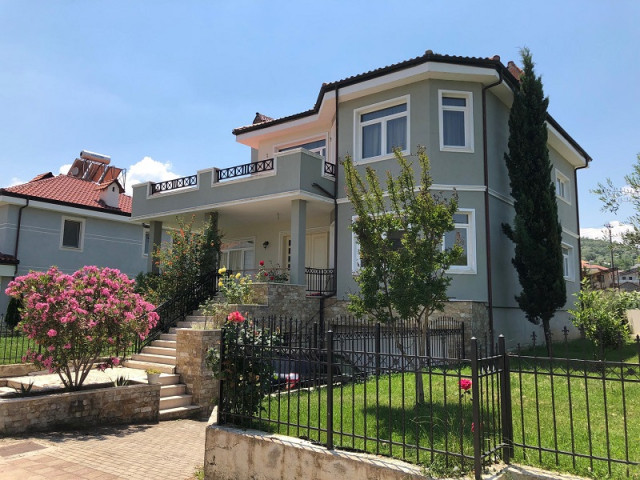
Typical Akacia Hills Villa
Additionally, some people will point out that the cultural options in Tirana are less than in Manhattan and that is undoubtedly true. While Tirana does have cultural events and some name entertainers do stop here on their tours, it is also the case that it is very easy to hop a plane for a few days to Rome, Athens, etc. Of course, you will suddenly be subjected to Western prices, but it is definitely better than living with them full time.

While one must speak Russian when living in Brest, Belarus, one need not speak Albanian to live in Blloku, Sauk or Lunder. It is true, if you go to live in an Albanian village in the interior of the country, as some retired Americans, in fact, do, you will find few people who speak English. However, in Blloku I almost never run into people who don't speak good to excellent English. The store signs are so routinely in English that I sometimes forget where I am.
If you live in Blloku, Sauk or Lunder, you can live a 3* or 4* lifestyle. However, that is not all. About a 40 minute drive west of Blloku is Shkembi i Kavajes, a small town on the Adriatic Sea. If you want, in the summer, you can rent two chaise lounges and an umbrella on the beach for the day ($6), and enjoy the services of Grand Blue Fa Fa, a true 5* resort hotel. There is a upscale club on the beach and there is good beach service. In reality, you will have a difficult time finding an equally gratifying 5* experience anywhere in the world.
If a weekend sounds good, rooms at Grand Blue Fafa are as low as 55USD, a crazy price for a 5* hotel. If you are willing to settle for a 4* hotel, you can go as low as $35 per night. I will never forget a spontaneous beachside lunch with 8 roasted shrimp each and pina collatas. The total cost was $30. As we sat there gazing at the ocean, I thought, "So this is Albania on a Social Security budget."
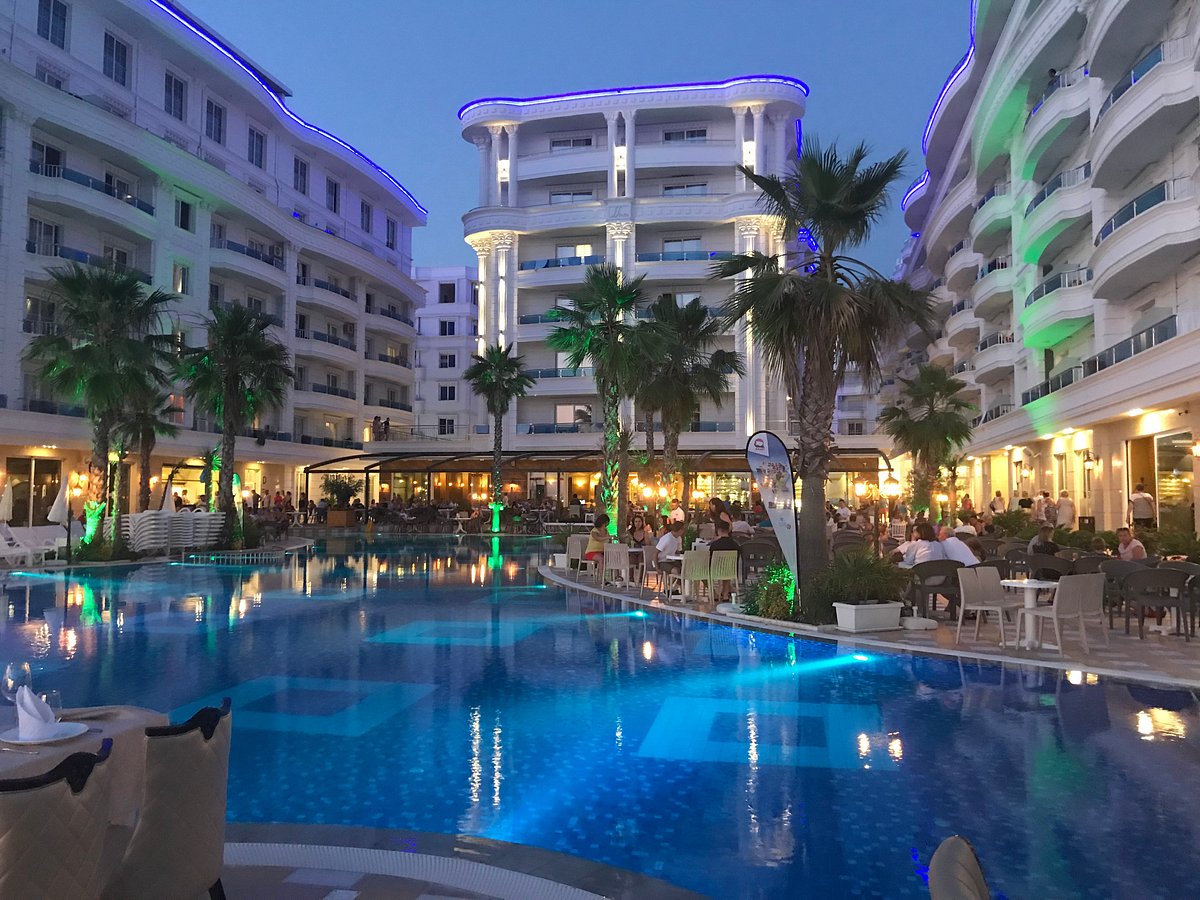 |
| Grand Blue Fafa |
To put it simply, you can stay in the U.S. and barely scrape by on a 2* lifestyle or move to Tirana and enjoy a 4* lifestyle. For example, I don't clean my apartment. I have a maid. I have enough money to go out any time that I don't feel like cooking and I can easily find a top restaurant within walking distance. In fact, we have a tradition of spending Saturday evening at the cafe at the Taiwan Center, about a 15 minute walk north of our apartment.

So if you, like so many Americans, are approaching retirement age or even have already reached it and have pared back on your lifestyle, you still have options to live graciously in your golden years. Mexico is an option. Albania is an option. There are other options in Latin America, Central Europe and South East Asia. We are all different in our tastes and preferences. However, one really should consider whether you should live in a place where $3,000 per month spends like $3,000 per month when you can choose to live where $3,000 per month spends like $10,000 per month. We chose the latter and after five years we have absolutely no regrets.
Follow me at MichaelWFerguson.substack.com

